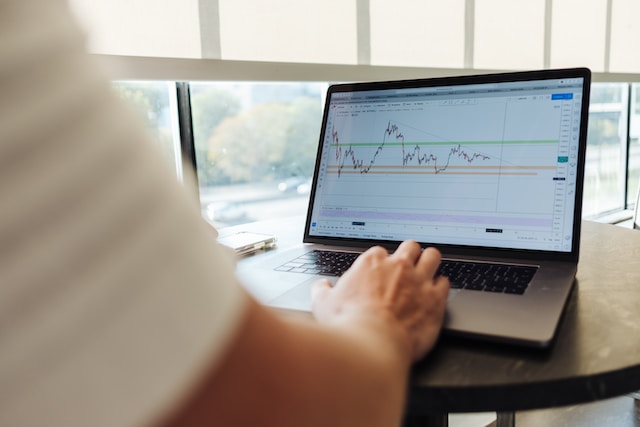
Automated trading software is reshaping how UK traders analyse markets. Explore how algorithms, back-testing and AI are changing analysis in London and beyond.
Not long ago, most retail traders in Britain analysed the markets in much the same way: a few charts on a laptop, a news feed open in another tab and plenty of time spent waiting for the right moment. That routine is now changing. A growing share of market analysis is now handled by software that scans prices, tests ideas against years of historical data and can act on a signal without anyone touching the keyboard.
The shift is not confined to the City's trading floors. Automated tools have found their way into home offices across the country, and they are reshaping what market analysis actually involves.
From Gut Instinct to Coded Rules
At its simplest, automated trading software turns a trader's rules into instructions a computer can follow. Someone might decide to buy a currency pair when a short-term moving average crosses above a longer one. Rather than watching for that moment, they write the rule once and let the software monitor the market.
MetaTrader 5 has become one of the best-known platforms for this kind of work. Its programming language, MQL5, lets users build expert advisors that automate strategies, design custom indicators and back-test ideas before any money is committed. The platform includes 38 built-in technical indicators and 21 chart timeframes, and its 64-bit, multi-threaded design handles heavier analytical workloads than its older sibling, MetaTrader 4.
Back-testing forces a trader to state exactly what they believe about a market and then measure it against the evidence. An idea that feels convincing on a single chart can look very different once it has been run across several years of price history.
Why London Is a Natural Fit for Automation
Britain's enthusiasm for these tools reflects its place in global finance. The Bank for International Settlements' latest Triennial Survey found that worldwide currency trading reached $9.6 trillion a day in April 2025, with the UK remaining the largest centre at around 38% of turnover.
Institutions have been at the cutting edge of trading tech. A joint Bank of England and FCA survey found that 75% of UK financial services firms were already using artificial intelligence, with a further 10% planning to do so within three years, up from 58% and 14% in the previous edition. Tellingly, only 2% of the use cases reported involved fully autonomous decision-making. Most firms still keep a person in the loop who can make the final call if needs be.
Analysis That Keeps Going After Hours
Currency markets trade around the clock during the working week, which has always been awkward for anyone with a day job. Automation can help fill that gap. An expert advisor can watch for a breakout during the Tokyo session, flag a pattern in New York hours and log every decision for review over breakfast.
Platforms have also absorbed tools that once sat elsewhere. Economic calendars now live inside many trading terminals, so a strategy can be set to stand aside around major releases such as UK inflation data or a Bank of England rate decision.
Pattern-recognition add-ons scan charts for support and resistance levels, and some traders with little coding experience now use generative AI assistants to draft basic strategy scripts before refining them through testing.
Lessons From the Sterling Flash Event
Automation has also changed how the market understands stress. In October 2016, sterling dropped by around 9% against the dollar during thin early Asian trading, before recovering much of the move. Bank of England analysis later noted that the fall played out in roughly 40 seconds.
A BIS Markets Committee report concluded there was no single cause. It placed significant weight on the time of day and on mechanical amplifiers, including options-related hedging flows. Its lessons fed into the FX Global Code, which now covers governance around algorithmic execution and asks participants to consider the wider effects of their trading.
The takeaway for individual traders is straightforward. A rule written for calm conditions may behave very differently when liquidity thins out, which is why stress-testing a strategy matters as much as fine-tuning it.
Regulators Are Studying the Next Wave
UK authorities are already looking further ahead. In its April 2025 Financial Stability in Focus report, the Bank of England's Financial Policy Committee said AI could improve market efficiency, while noting that firms using similar models might end up taking increasingly correlated positions during periods of stress.
That theme gained momentum earlier this year when Parliament's Treasury Committee called for AI-specific stress tests. The Bank responded in the spring, explaining that it is working with international counterparts on simulations of how AI trading agents might behave together under pressure. A new Bank of England and FCA survey covering generative and agentic AI closed in July, with results expected before the end of the year.
Wrap Up
Trading has always had tools to help traders make better market decisions. Automation is just the latest in a growing toolkit that has the possibility to make engaging in trading more accessible and also more strategic for those who are already seasoned traders.
Automated software has not removed judgement from trading so much as moved it earlier in the process. The real trading decisions now happen when choosing which rules to code, how rigorously to test them and when to switch a system off. Many experienced traders treat automation as an analytical assistant rather than a replacement, trialling strategies on demo accounts before going live and reviewing performance reports regularly.
For UK traders, these tools are more accessible than they have ever been. Used with clear rules and realistic expectations, they offer a more disciplined, evidence-led way to make sense of fast-moving markets.